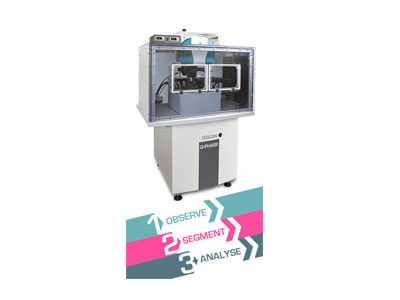
Q-PHASE: Quantitative, label-free imaging cytometry
Home > Products > Tescan
Q-PHASE a valuable research tool for biological and biotechnical applications such as testing reactions of cells to a speci c treatment – even with scattering non-transparent substances, monitoring cell’s life cycle including mitosis, distinguishing between di erent forms of cell deaths, analyzing cell growth, motility or morphology changes, imaging cells in extracellular matrices.

Features
- Simple Automated Image segmentation and processing – comparable to fluorescence data processing
- No image artifacts such as halo effect (as opposed to techniques based on Zernike phase contrast illumination)
- Enables very precise detection of cell boundaries
- Label-free – no staining is needed, simple sample preparation, observation of live cells in their native environment, no photobleaching problems
- Low phototoxicity – low light power density (107 × lower than fluorescence microscopy) allows long-term observations (for days)
- Coherence-gating effect – Q-PHASE special feature enabling to observe samples even in scattering media (phospholipid emulsions, extracellular matrices, etc.)
- Multimodality – fully integrated fluorescence module, simulated DIC and brightfield which enables automatic multimodal imaging of the sample
- High-quality QPI – unique Q-PHASE’s optical setup allows using incoherent illumination which provides extraordinary imaging quality without any compromises
- Strong suppression of coherent noise (speckles) & parasitic interferences (as opposed to laser-based approaches)
- Lateral resolution of conventional microscopes (up to 2× better when compared to common laser-based approaches or pinhole spatial filtering based techniques)
- Fast acquisition – the use of off-axis holographic approach makes Q-PHASE a single-shot instrument, thus enabling imaging of very fast cell dynamics
- Full motorization – focusing, sample stage, objective exchange, fluorescence filters
- Automated multidimensional acquisition – time-lapse, channel, position, Z-stack
- Quantitative – phase values can be recalculated e.g. to cell dry-mass density (pg/μm2) or direct topography with nanometer sensitivity (usually non-biological samples with homogeneous refractive index distribution)
- High phase detection sensitivity – enables to detect even the smallest changes in axial direction, very sensitive detection of morphology or position changes